
WELCOMING ASSISTANCE DOGS IN YOUR COMMUNITY
Public Access Rights
Assistance Dogs play an essential role in helping people with disability live safely, independently, and confidently.
It’s important for businesses, organisations, and the public to understand the legal rights that allow these dogs to accompany their handlers in most public places.
Here’s everything you need to know about Assistance Dogs, their role, and how you can help make our communities more inclusive.
Thank you for opening your doors to Assistance Dogs
We at Assistance Dogs Australia feel it’s important for everybody to know about the great work Assistance Dogs do in our communities, and the laws that make this work possible.
This page will help to answer questions about Assistance Dogs, what they do, and their rights in the public. We hope this will help you welcome Assistance Dogs in.
Download the Public Access Rights of Assistance Dogs PDF here.
Public access rights FAQs
An Assistance Dog is any dog that is helping a person with a disability and has met the state standards for public access rights.
Assistance Dogs can help with a range of conditions. They can help people with physical disabilities and limitations complete day to day tasks around their homes and in the community. They can help people with psychological conditions, like PTSD and Autism Spectrum Disorders, feel safe, calm and confident when out in public spaces.
They provide highly specialised skills to address specific needs a person might have. Guide dogs for the blind and deaf are technically Assistance Dogs.
The rights of a person with an Assistance Dog are protected under Federal Law through the Disability Discrimination Act 1992 (DDA 1992). The DDA recognises that a suitably trained Assistance Animal is a tool facilitating the functioning of a person with a disability, similar to a wheelchair. The DDA recognises both physical and psychosocial disabilities and acknowledges that an Assistance Animal can assist in either case. The DDA allows qualified Assistance Dogs to accompany their handler into all public spaces. The only exceptions to this may be spaces in which a person’s disability is being addressed by other means, or areas with stringent sterility requirements, for example:
- Specific Clinical Settings
• Surgically sterilised areas
• Industrial food preparation areas (kitchens)
• Quarantined areas
Assistance Dogs are a necessary aid to allow a person with a disability to engage in their community. You wouldn’t ask someone who needs a walking stick to leave it at the door.
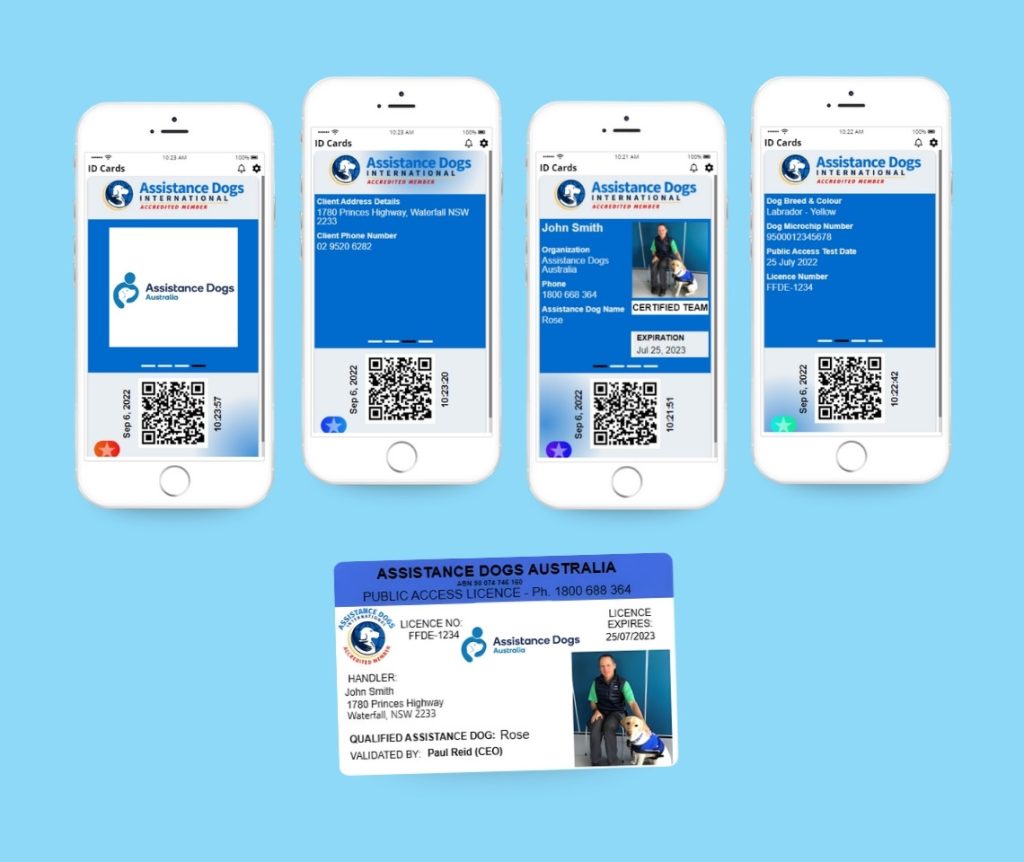
You are legally allowed to ask for some documentation showing that the Assistance Dog is qualified, accredited, and serving the person they are with. We encourage you to do this, but ask that you do so with sensitivity and respect.
An Assistance Animal will have a jacket with branding from the organisation that qualified it – a photo of Assistance Dogs Australia’s jacket on a dog is included as an example below. You can expect the dog to be clean, well maintained, very well behaved, and highly obedient to its handler.
It is best to just ignore the Assistance Dog as much as possible. You can think of the dog like a wheelchair. If you would not, touch, stare at, or ask about a person’s wheelchair, then it’s best to do the same for their Assistance Dog.
Contact us
If you have any further questions regarding the rights of Assistance Dogs, or the laws specific to your state, here are the contact details for the relevant human rights organisations.
Australian Human Rights Commission
humanrights.gov.au/about-us/contact
(02) 9284 9600
Attorney General’s Department
www.ag.gov.au/About/Pages/Contactus.aspx
(02) 6141 6666
NEW SOUTH WALES
New South Wales Public Service Commission
www.psc.nsw.gov.au/contact-us
(02) 9272 6000
AUSTRALIAN CAPITAL TERRITORY
Australian Capital Territory Human Rights Commission
www.hrc.act.gov.au/contact-us
(02) 6205 2222
QUEENSLAND
Anti-Discrimination Commission Queensland
www.qhrc.qld.gov.au/contactus
1300 130 670 (state wide)
NORTHERN TERRITORY
Northern Territory Anti Discrimination Commission
https://adc.nt.gov.au/contacts
1800 813 846
TASMANIA
Equal Opportunity Tasmania
www.antidiscrimination.tas.gov.au/contact_us
1300 305 062
VICTORIA
Victorian Equal Opportunities & Human Rights Commission
www.humanrights.vic.gov.au/get-help/contact-us
1300 292 153
SOUTH AUSTRALIA
South Australian Equal Opportunity Commission
www.equalopportunity.sa.gov.au/about-us/contact-us
(08) 8207 1977
WESTERN AUSTRALIA
Western Australia Equal Opportunities Commission
[email protected]
(08) 9216 3900
State Specific Legislation
QUEENSLAND
www.legislation.qld.gov.au/view/html/inforce/current/act-2009-004
SOUTH AUSTRALIA
dogandcatboard.com.au
WESTERN AUSTRALIA
https://www.dlgsc.wa.gov.au/local-government/community/cats-and-dogs/applying-for-assistance-dog-approval
Contact us
You can contact Assistance Dogs Australia at [email protected] or 1800 688 364.
If you have any further questions regarding the rights of Assistance Dogs, or the laws specific to your state, here are the contact details for the relevant human rights organisations.
Australian Human Rights Commission
humanrights.gov.au/about-us/contact
(02) 9284 9600
Attorney General’s Department
www.ag.gov.au/About/Pages/Contactus.aspx
(02) 6141 6666
NEW SOUTH WALES
New South Wales Public Service Commission
www.psc.nsw.gov.au/contact-us
(02) 9272 6000
AUSTRALIAN CAPITAL TERRITORY
Australian Capital Territory Human Rights Commission
www.hrc.act.gov.au/contact-us
(02) 6205 2222
QUEENSLAND
Anti-Discrimination Commission Queensland
www.qhrc.qld.gov.au/contactus
1300 130 670 (state wide)
NORTHERN TERRITORY
Northern Territory Anti Discrimination Commission
https://adc.nt.gov.au/contacts
1800 813 846
TASMANIA
Equal Opportunity Tasmania
www.antidiscrimination.tas.gov.au/contact_us
1300 305 062
VICTORIA
Victorian Equal Opportunities & Human Rights Commission
www.humanrights.vic.gov.au/get-help/contact-us
1300 292 153
SOUTH AUSTRALIA
South Australian Equal Opportunity Commission
www.equalopportunity.sa.gov.au/about-us/contact-us
(08) 8207 1977
WESTERN AUSTRALIA
Western Australia Equal Opportunities Commission
[email protected]
(08) 9216 3900
State Specific Legislation
QUEENSLAND
www.legislation.qld.gov.au/view/html/inforce/current/act-2009-004
SOUTH AUSTRALIA
dogandcatboard.com.au
WESTERN AUSTRALIA
https://www.dlgsc.wa.gov.au/local-government/community/cats-and-dogs/applying-for-assistance-dog-approval