
PTSD ASSISTANCE DOGS
Supporting Australians Living with PTSD
Our PTSD Assistance Dogs provide more than comfort – they offer calm, confidence, and connection.
Specially trained to support people living with post-traumatic stress disorder, these remarkable dogs help restore independence, ease anxiety, and bring a renewed sense of safety to everyday life.
Applications temporarily closed
Due to overwhelming demand, we have temporarily closed the application process for this program. We are working hard to reopen the process and provide the best service we can to those who could benefit from one of our extraordinary dogs.
This page will be updated when applications reopen for this program.
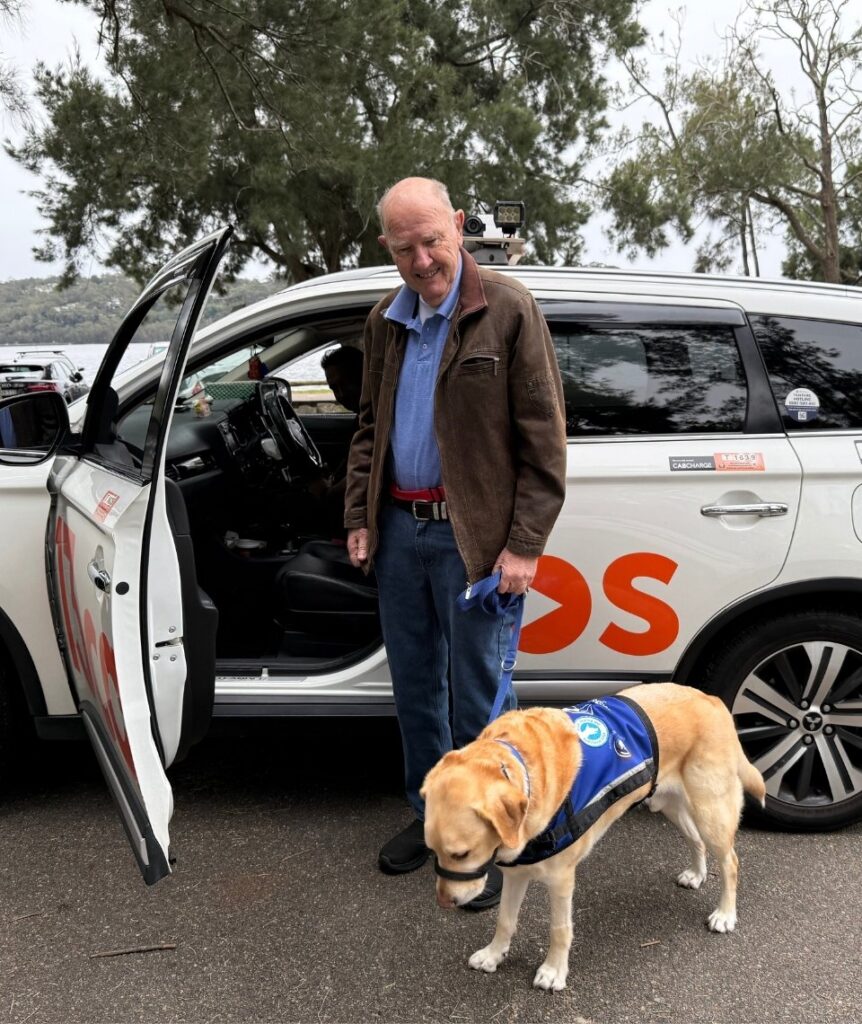
Assistance Dogs Australia’s program for people living with PTSD
PTSD (Post Traumatic Stress Disorder) Assistance Dogs are trained to reduce the impact of specific symptoms for people living with this condition, and improve their overall quality of life.
Assistance Dogs can help guide those living with trauma back to a sense of safety, helping to improve interpersonal connections, encourage engagement in the community, and regain areas of functioning that may have been diminished by their trauma.
All Assistance Dogs Australia trained and qualified dogs have full Public Access Rights, allowing them to accompany their handlers on all public transport and into almost all public areas. These rights are protected under Federal law*.
Our dogs are trained to the highest standards, and are accredited by Assistance Dogs International.
Our program provides Assistance Dogs to successful applicants free of charge, entirely funded through charitable donations from individuals and corporations. Our program considers applications regardless of race, gender or religion.
While we wish we could open our program to all those living with post trauma stress, Assistance Dogs Australia is currently only placing dogs with former Australian Defence Force, Police personnel and Fire Fighters diagnosed with PTSD.
What is PTSD?
All of us will experience some form of trauma during our lives, and most of us will recover without long-term difficulty. Some people who are repeatedly exposed to traumatic events, or experience a particularly traumatic incident, may go on to develop PTSD (Post-Traumatic Stress Disorder).
Our bodies instinctively respond to threat to help us survive-to get away, fight the threat, or slow down to let the threat pass. This is known as the Flight/Flight/Freeze response. Intense or repeated trauma can lead to this response becoming extremely sensitive.
When this happens almost any environment becomes threatening, and anything relating to the traumatic incident provokes an activation of the Flight/Flight/Freeze response. This contributes to many of the symptoms we associate with PTSD:
- Re-experiencing trauma when reminded of it
- Avoiding reminders of trauma
- Low mood or depression
- Severe anxiety
- Reactivity, irritability, and agitation
- Disturbed sleep and nightmares
- Dissociation
Significant psychological, social, and functional difficulties may come out of this. PTSD is particularly prevalent in former military and police personal who often endure exposure to traumatic incidents in the course of their duties. Up to 25% of Australian Defence Force personnel who have transitioned out of active duty, and 20% of police, would meet criteria for a diagnosis of PTSD.
How can an Assistance Dog help?
Assistance Dogs help people with PTSD in two ways; Advanced Skills Training, and the Human-Animal Bond:
1. Advanced Skills Training:
All ADA dogs undergo rigorous preparations for up to two years, including 16-20 weeks of advanced skill training. Our dogs master bespoke cues aimed at addressing PTSD-specific areas of difficulty, including:
- Positioning cues, which allow the handler to position the dog as needed and create space for themselves in public or crowded places, allowing for an increased sense of security and encouraging community engagement.
- Contact cues, which allow the handler to request physical contact facilitating grounding, mindfulness, and focus.
- Nightmare interruption, which allows a dog to recognise signs of distress in sleep, or immediately after waking, and provide support for calming.
People living with PTSD often show external signs associated with their stress response (e.g. bouncing legs, rubbing hands, breathing heavily, sweating excessively etc.). Our PTSD dogs are trained to use these external signs as cues for relevant skills to provide support when it is needed most.
Our training is highly personalised, shaping the dog’s skills to individual needs. We encourage and support ongoing skill development in our dog teams.
2. The Human-Animal bond:
The close bond between a person and their dog encourages a sense of safety which can be tremendously beneficial for people living with PTSD.
The calming influence of a dog can help reduce both physical and psychological reactivity which is particularly relevant for people who have experienced trauma.
By tapping into this calming effect using grounding techniques, an Assistance Dog can reduce the threat response allowing for increased community engagement and calmer interpersonal interactions.
We work with successful applicants to encourage a strong bond with their dogs, and through this bond, gain the skills and motivation they need to reach their goals.
The Public Access Rights granted to Assistance Dogs allow this calming influence to be present as needed throughout the day, across almost all settings.
*Assistance Animal Public Access Rights are protected under federal law through the Disability Discrimination Act 1992. People who receive a PTSD Service Dog are provided with a photographic identity badge as proof of Service Dog status, which they must take with them in public, and a Service Dog jacket for the dog.
Criteria
- The applicant must have an accepted diagnosis of post traumatic stress disorder (PTSD).
- The applicant must be currently engaged in treatment with an appropriate mental health clinician and have been doing so for at least three months.
All Applicants and/or primary dog handlers must meet the following general criteria:
- Be aged 18 years or older. If under 18, the applicant must have a legal guardian aged 18 years or older who will become the nominated ‘primary handler’ of the dog, is living with the applicant, and will be responsible for the dog at all times.
- Complete our Health Professional form.
- Be deemed suitable by ADA after completing the assessment process.
- Accept the financial responsibility and provide the resources to care for the dog (ie. meet vet bills, premium food and equipment) throughout the dog’s life.
- Provide the dog with a secure home, with a commitment to maintain the quality of the dog’s training, health, wellbeing, exercise and mental stimulation.
- Have current stable living arrangements to house an Assistance Dog.
- Have a consistent safe outdoor area for toileting and exercise.
- Nominate at least two suitable adults who will, if required, provide immediate care of the dog in an emergency or unforeseen circumstances (eg. hospital stays).
- All people living in the household must support the application.
- No members of the household have a history of, or current behaviours relating to, abuse, neglect or non-sanctioned violence towards humans or animals
- If any member of the household has an allergy to dogs, it must be manageable.
- All existing pets in the home must be appropriately vaccinated, on correct preventative medications (heartworm, flea, tick and intestinal worms) and will be assessed on a case-by-case basis for temperament. Pet dogs must be desexed and over the age of one year.
Please note that Assistance Dogs Australia will consider all applications regardless of race, gender, religion, and/or sexual orientation.
Journey Flow
Submission of initial interest for an Assistant Dog
1
Information
Session
2
Application
Form
3
Suitability Assessment
4
Accepted onto Waiting List for dog matching
5
Retirement support and possible application for a Successor Dog
9
Long Term ADA Support & Follow ups
8
Placement Training Class
7
Pre-Class Preparation
6
Selected bibliography
American Psychiatric Publishing. (2013). Diagnostic and statistical manual of mental disorders (5th ed.). Arlington.
Australian Centre for Posttraumatic Mental Health. (2013). Acute stress disorder and posttraumatic stress disorder (2nd ed.). Melbourne.
Beetz, A. (2017). Theories and possible processes of action in animal assisted interventions. Applied Developmental Science, 21(2), 139-149. doi: 10.1080/10888691.2016.1262263
Fine, A. (2019). Handbook on Animal-Assisted Therapy. San Diego: Elsevier Science & Technology.
Van der Kolk, B. (2015). The body keeps the score. New York (New York): Penguin Books.
Van Hooff M, Lawrence-Wood E, Hodson S, Sadler N, Benassi H, Hansen C, Grace B, Avery J, Searle A, Iannos M, Abraham M, Baur J, McFarlane A. (2018). Mental Health Prevalence, Mental Health and Wellbeing Transition Study. The Department of Defence and the Department of Veterans’ Affairs. Canberra.