John’s life transformed thanks to his Assistance Dog Yoda
John's life transformed thanks to his Assistance Dog Yoda Safety, comfort and confidence thanks...
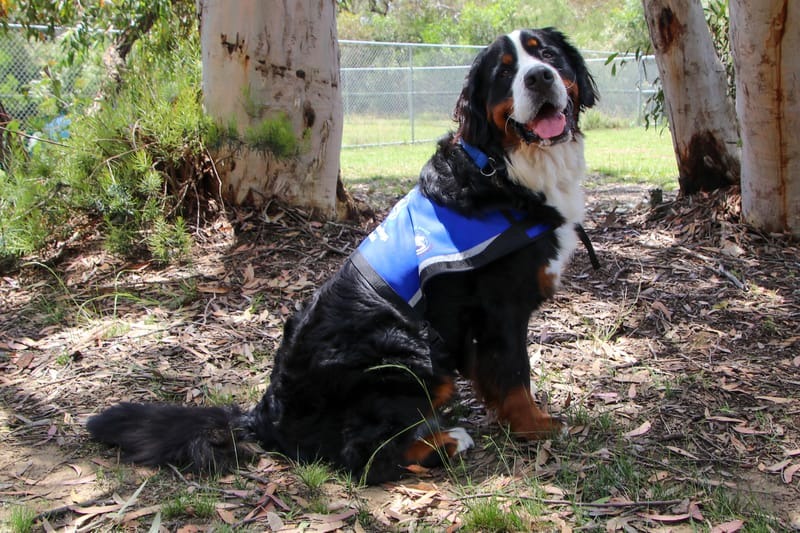
A Service Dog is another term for an Assistance Dog. The phrase “Assistance Dog” is more commonly used in Australia.
Assistance Dogs are specially trained for over two years to help a person who is living with a disability. Assistance Dogs are considered to be medical aids.
Assistance Dogs Australia train Assistance Dogs for people living with a physical disability, autism, or Post-Traumatic Stress Disorder (PTSD), and also Educational Support Dogs for schools who cater for children with additional learning needs.
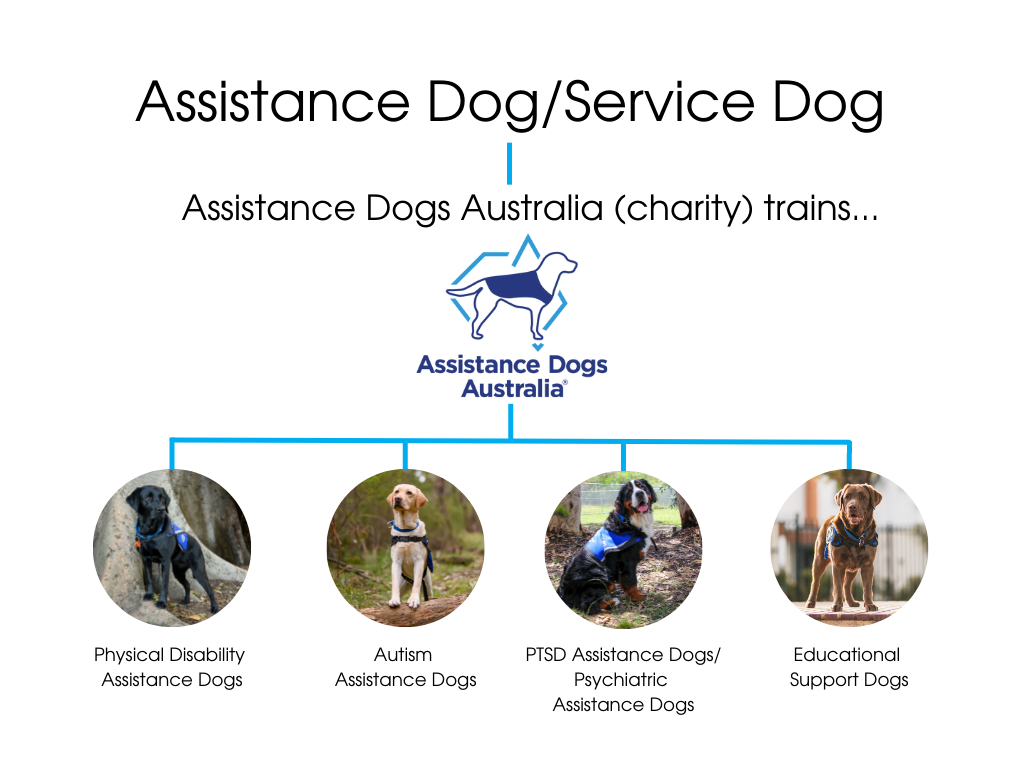
An Assistance Dog who helps someone living with PTSD is also known as a Psychiatric Service Dog.
A Psychiatric Service Dog can also help people who have conditions such as anxiety, depression, schizophrenia, or bipolar disorder.
Due to high demand, we can only provide Psychiatric Service Dogs with former servicepeople, first responders such as police, paramedics and fire fighters diagnosed with PTSD.
At some point in our lives, most of us will experience a level of trauma. Many will recover over time, but others may develop PTSD, especially if they are repeatedly exposed to traumatic events or experience an extremely traumatic event.
PTSD can significantly disrupt someone’s life, as well as their loved ones and those close to them.
Some symptoms of PTSD include:
It can be hard to fully comprehend the horrors of living with PTSD unless you or a loved one have experienced it.
Don has been living with Post-Traumatic Stress Disorder (PTSD) for over 30 years. He has spent 45 years as a first responder, initially as a policeman for five years, and then a paramedic for the rest of the time.
He loved his career, but the things he saw and experienced took a terrible toll. Don medically retired from his career in 2016.
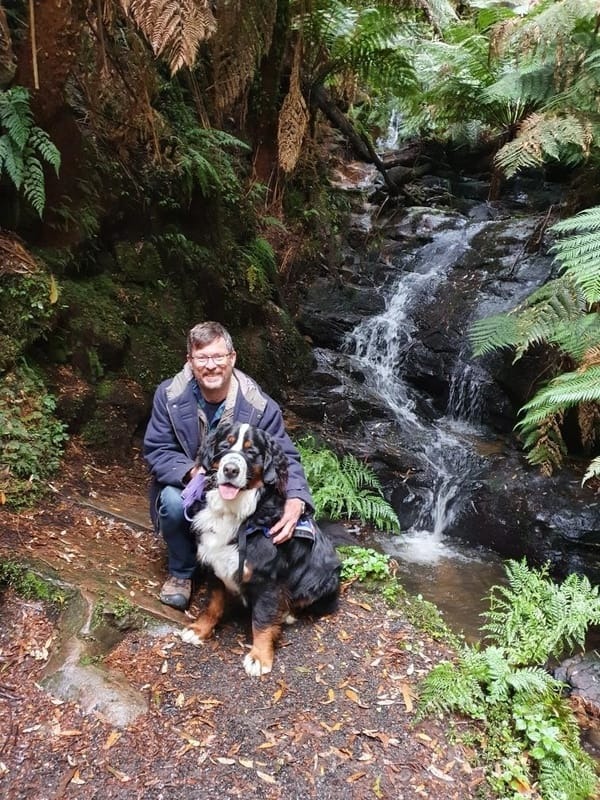
He now has Bernie, our one and only Bernese Mountain Dog, as his Psychiatric Service Dog to help him rebuild his life.
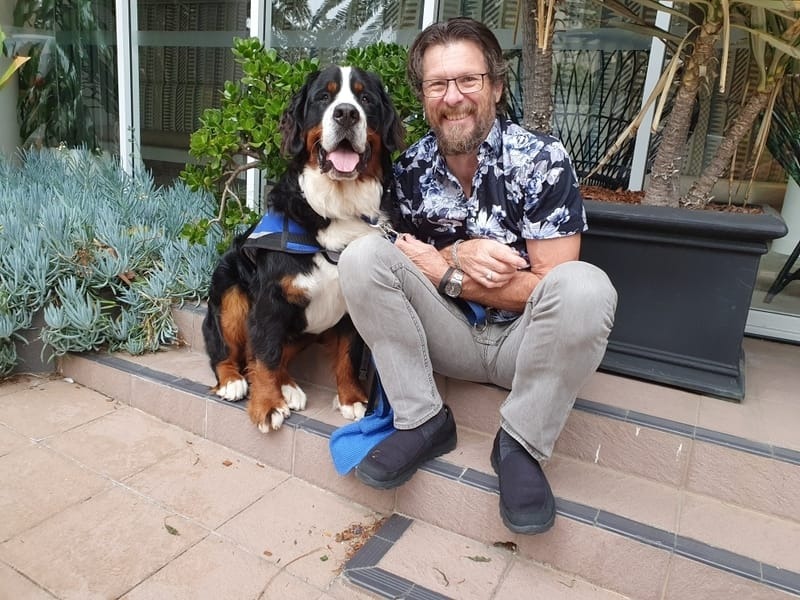
In Don’s own words, this is what PTSD is:
“PTSD presents itself fairly commonly with the veteran/first responder community with flashbacks, nightmares, sleeplessness, depression, and anxiety out of nowhere.
Part of the issue is the chemistry of things. When you get a scare, a shock, a fright, when you get put into a high-adrenaline situation, you release adrenaline and then cortisol (stress hormone). Then the fight or flight mechanism kicks in.
It happens to absolutely everybody, certainly a couple of times a week if not almost every day you get a bit startled, and get that little release of adrenaline to spark things up, and then the cortisol to bring things down.”
Constant exposure to intense stress can eventually damage mental health. Don explained:
“If you imagine veterans and the first responders, we’re constantly dialling up the adrenaline release, for entire shifts, so 14 hours at a time.
And after a while, that alters the whole chemical balance, so you literally can’t dial down, the cortisol doesn’t release. You’re staying in this heightened sense of threat, and it is physically and mentally exhausting.”
PTSD destroys lives. People find different ways to cope, not all of them healthy. Relationships start to deteriorate. Don said:
“Almost as a self-protection mechanism, your feelings cauterise, you sort of become what appears to be insensitive and blunt to people. Friends and family who don’t understand will often just drop off, because they don’t know how to deal with you, and you can’t deal with them. It invades all areas of life.”

It becomes extremely difficult to function every day, not knowing if you will fall apart at any moment. Without warning, Don can be triggered doing everyday things. It makes it hard to resume everyday life. He said:
“I’ve lived and worked in the same area for about 20 years.
Now driving along, I’ll be driving down the road past a certain tree, and suddenly without even thinking about it, I’ll remember attending to a fatality at that site and I’ll remember the state of the person… no warning, and you’re back there. Everything, all of the sensations that were there, all come back. It’s just exhausting.”
PTSD episodes can happen anywhere, at any time, which meant that Don was reluctant to leave home. Because Don lived and worked in the same area, he would be reminded of traumatic events just by driving around town. Don said:
“I used to have panic attacks really regularly. And at times if I was driving, I’d have to pull over, or if I was at home I’d just sit down, and there’s various strategies you can use to work through them, but it would take long periods of time.”
PTSD is most often treated with a combination of medicine and therapy, but everyone is different and there is no treatment that is guaranteed to work for everybody. However, Psychiatric Service Dogs can help to reduce the severity of PTSD and help people to rebuild their lives. This is how Medical Assistance Dogs, otherwise known as Psychiatric Service Dogs, help people living with PTSD:
One of the major ways that Bernie helps Don is by being his second shadow, especially when they are out of the house.
This is only possible because of Bernie’s public access rights, which only accredited Assistance Dogs have because they have been specifically trained to be quiet, block out distractions, and perform skills to help their owner in public spaces.

With Bernie, Don is experiencing fewer panic attacks and when he does have them, they are less severe. Don gained confidence to do things again. He said:
“We actually went to the movies, and there was this scene that triggered me.
I was getting a bit distressed and shaky, so Bernie bumped my leg, and I just reached out and hung onto him.
18 months ago I would have had to have left the theatre, I wouldn’t have been able to probably stay. I was able to just work through that with him.”
Psychiatric Service Dogs compliment existing care plans, and are not intended to resolve the trauma or replace medicine.
However, since receiving Bernie, Don has been able to wind back on all of his medications, in consultation with his psychiatrist. Don said:
“Bernie has been more effective than a lot of medications have been for years prior to him. And so, that’s allowed me to drop some of those medications. Two of them were fairly heavy-duty, they really impacted on my capacity to function.
These medications made me very tired, a bit listless, a little bit disinterested in things. You weren’t having really bad negative, depressive days, but you also didn’t feel a whole lot of joy either, everything was very beige, which was not very pleasant.
And they also were quite strong medications that were not good physiologically for long-term usage. They were bad for kidney function and liver function, so it was good to cease them.”
Don said he has reduced his main medication by 25%, with the aim to stop taking the medication by the end of the year.
And significantly, Don has not needed his anti-anxiety medication the whole time he’s had Bernie.
While every person’s experience is individual, Don’s story underscores the results of a client questionnaire we conducted with the University of Sydney in 2019, which said:
Assistance Dogs are miracle workers, helping their humans to progress in ways they didn’t think were possible.
Not only do they bring joy and companionship, but they are also vital medical aids who can give support whenever they are called upon.

Today, Don is a lot more confident in leaving the house and doesn’t have to depend solely on his wife to support him in challenging moments.
Don is now making plans for his future.
Very recently, Don has applied to work as a vaccinator at COVID vaccination hub in Victoria. He is looking forward to work that builds on his past as a policeman and paramedic, and also fits in with his ethos of helping the community. He said:
“So here we are six years after I finished working, and I’m able to now look at getting back and doing some meaningful work, which is also pretty good for my self-esteem as well.
I’ve gone from being reclusive and not able to be productive for a number of reasons, and here we are down the track now, I’m able to get back and give back. So the community is benefiting from Bernie too.”
While Don knew that an Assistance Dog could help him, he is amazed at how much Bernie has improved his life.

Because of Bernie, Don’s confidence and zest for life has returned. He is eager to continue giving back to the community through his work, and has found purpose again.
If you would like to learn more about our PTSD Assistance Dog Program, click here.
John's life transformed thanks to his Assistance Dog Yoda Safety, comfort and confidence thanks...
Celebrating one year of Puppy Kindergarten! This January, Assistance Dogs Australia is proud to...
Meet Instructor Georgia: Connecting to people – through dogs How Instructor Georgia creates meaningful...